My name is William Paterson I was born December 24,
1745 in County Antrim and moved to the
United States at the age of two. When I was fourteen I entered the College of
New Jersey , where I studied law with Richard Stockton. I was admitted into the
bar in 17683, a culmination of my perilous efforts I founded the Cliosphic
Society along with Aaron Burr.
I was elected as Somerset County, New Jersey
delegate for the three provincial congresses of New Jersey and as secretary I
recorded the New Jersey Constitution. I
was appointed as the first Attorney General of New Jersey serving from 1776 to
1783, I established myself as one of New Jersey’s most prominent lawyers. In 1787 I was sent to
the Philadelphia Convention where I proposed the New Jersey Plan. This plan
called for a legislative body with equal representation from each state, which
was resolved by the Great Compromise:
the Senate had equal representation for each state and the House of Representatives.
The
Great Awakening was a religious revival during the 1730’s to the 1740’s, that created
the questioning of the individual within religious society. The Great Awakening
started when King Henry forced his subjects to follow his religion. The
movement evolved into a personal approach instead of following doctrine. The
Great Awakening evolved on the idea that religion should happen at a personal level
directly between God and the Individual. Protestant denominations established their own
churches: Quakers, Anglicans, Baptists, and Presbyterians are some of the major
denominations. The Great Awakening caused a break in the foundations of the
established churches, making followers question otherwise injected ideals from
the Mother Country.
Between
1607 and 1775, Slavery in the southern colonies grew resulting from the “necessity”
of profit. Blacks were removed from Africa and inhumanely treated in the
colonies, leading to American dependence on profitable plantation systems that
were reliant on slavery; thus, creating a new social system based on race.
The Trans-Atlantic Slave trade is a form of
Triangular trade, which, as the names implies is trade in the form of a
triangle connecting three countries. The Trans-Atlantic slave trade connected
Africa, the New England colonies and Africa. Western Civilization labeled
Africa as the “Dark Continent” , because they knew little to nothing about the
people. Slavery had existed before the trade system, typically within Africa when
tribes fought members of the losing
tribe might become slaves. Unlike Slavery in the Americas, known for its amount
of sheer brutality and basis in inferiority , slaves in Africa had rights: they
could marry, and live within their master’s houses. Africa was founded on
powerful kingdoms: Ghana, Mali, and Songhuay, complex trade: with Arabs,
Europeans, and other African communities, and wealth from resources: gold,
salt, iron, copper and diamonds. Once
the Colonies of Georgia. The Slave trade ruined West Africa as entire villages
wound disappear, guns and alcohol were introduced, tribes turned on each other.
This is known as the Diaspora of the African people which marked the dispersal of
the African people from their homeland. the Carolinas and Virginia established success
on cash crops: tobacco, rice and indigo. Colonists had troubles adjusting to
their new environments, the population declined as they suffered from outbreaks
of Yellow Fever and Malaria; meaning that the southern colonies needed a new
labor force. The colonies had resources while the England needed resources but
had rum, and Africa had laborers. For example a skipper from England would leave for the New England colonies, he
would sail to the Gold Coast of Africa and barter their liquor for slaves. With
their newly equipped cargo these skippers traveled to the West Indies through the Middle Passage
would use either tight or loose packing
to “organize” slaves . The Middle Passage took three weeks, slaves would be fed
twice a day, and would have small breathing holes. Once they reached the West
Indies slaves would be auctioned off to the Sugar islands, then the rest of the
cargo would be taken to the colonies and join the cash crop business. The skipper
would pick up a load of cash crops and take them back to England, and the Trade
System would repeat. Two prominent figure in the abolition of the Trade System
in America were the Religious Society of Friends (also known as the Quakers)
and William Wilberforce. The Slave trade Act of 1794 did not allow American
ships to be used for slave trade, in 1807 Congress outlawed the importation of
slaves, while the Treaty of Paris in 1814 both France and England abolished
slave trade. In 1859 the last slave ship to American soil which illegally
smuggled slaves into Mobile, Alabama, Georgia.
Thesis:
English colonies fervently believed in the rights given to the British during the
Glorious Revolution . However, the acts established by the British Imperial
rule during 1736 and 1776 that were placed upon the colonists left many disillusioned
with the government am began to demand the
republican values given to men in the Mother country. The governmental policies
of England had a wavering effect on the political, economic and social issues
of the American colonies. The English Bill of Rights inspired colonists to
protest virtual representation and excessive British taxes.
After the death of Queen Elizabeth I the country had to find
an heir to the throne, since she left no
children, King James I succeeded as King. The Glorious Revolution originally
took place in England with the overthrow of King James II and the replacement
of William III (of Orange) and his wife Mary II of England. The Glorious Revolution
in turn provided a chance for American colonist to claim their rights as
Englishmen which should have rightfully been theirs. However, Parliament argued
that everyone under the control of the English crown was represented, through
virtual representation. England, passed the Sugar Act, Currency Act, Quartering Act, and Stamp Act. This sparked resistance
within Colonists, in the forms of rebellion specifically the Jacobite rising,
the seven Years war and the American revolution . The Rights of the English
were found in the English Bill of Rights; which stated freedom of speech, no
taxation without representation, freedom to petition are only but a few examples
that the Bill presented for Englishmen.
The
seven Year’s war is regarded by many historians as the first World War, which
involved the Spanish, French, and British. The war took place in Europe,
Prussia, Russia, the Philippines, Africa and the Americas. The Seven Year’s war
was a product of tension between the French and British over land in North America,
the seven years was moved into action when the governor of Virginia ordered
George Washington to lead troops into the Ohio area, which was French territory,
in order expand its empire in North America. George Washington was forced to
surrender, France saw this as a start of hostilities and joined forces with Spain. The “Mother country” passed the Stamp Act,
Sugar Act, Quartering Act, and the Proclamation of 1763 aimed at imposing taxes on Americans in
order cover their fees for being involved in the war. These taxes made no sense
to the Americans, they viewed, that after years of neglect suddenly Britain
focuses attention to them only to tax them for a war they themselves did not
choose. These colonist did not accept these taxes and in 1767 Britain suspended the Legislature of New York for
failure to comply with the Quartering Act. In 1768, two British regiments
killed and wounded eleven citizens including Crispus Attucks, a mulatto. In 1775 the a British cargo ship full of tea
was stationed at the Boston Port, colonists dressed as Native Americans and
dumped all of the tea into the Harbor, this became known as the Boston Tea
Party. British parliament angered by this passed the Quebec Act, which closed
Boston’s port, limiting Bostonian trade. Colonists were both resilient and
dedicated to establishing their rights as British citizens, creating a basis
for the ideas of the American Revolution and the Enlightenment.
The Enlightenment was a revolutionary period in
English history where people began to accept the ideologies of the inherent
rights of man. The Enlightenment movement was concentrated in England and
gradually spread into the New England colonies. John Locke, philosopher,
believed in the “natural rights of man” which were: the right to life, liberty
and property. John Locke’s “natural rights of man”, were later adopted into the
American Declaration of Independence in 1776, where government is stated to
protect the inherent right of man: life, liberty and the pursuit of happiness. Baron
de Montesquieu, another Enlightenment philosopher, believed in the separation
of powers creating 3 branches: the legislative, executive, and Judicial. The
separation of powers omitted corruption from one party to enter government, today
of which is known as the system of checks and balances. The splitting into
different branches gave the governed the right
to overthrow a government that they think is unfair. Thomas Hobbes,
philosopher, believed in the idea of a “social contract”, a contract between
the government and the governed which is not actually signed.
Blog #5: Historical Figure during the Colonial period
ANNE HUTCHINSON
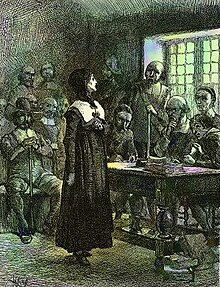
Portrait of Anne Hutchinson
What specifically is it that sets me apart from the other women of her time? I, unlike other women of my time, was not passive or submissive; however, I proved to be one
of the first prominent female figures within Colonial History for openly going
against the Boston Church.
Anne Hutchinson statue in Rhode Island
I born Anne Marbury in
Lincolnshire, England in 1591 and was the daughter of an Anglican minister, Francis
Marbury. Marbury, my father, felt that the clergy
should be well educated clashed with common ideas at the time and was
imprisoned years before my birth, in 1580, he was released, he then preached
and taught in the small market town of Alford, by 1585 he became schoolmaster
at the local Grammar School. I was the third child out of fifteen, my father’s influence, provided me with a powerful insight to a better education
than most girls my age. A female during the 16th century within
England, was privileged with education only if their family held a high social position;
education, at the time was offered exclusively to and dominated by males. My father died in
1611, in 1612 I William Hutchinson, my husband and I were exposed to preacher John
Cotton; an English clergyman and colonist. Cotton moved to Boston, New England
where he would study to become a minster,we were so inspired by Cotton that we decided to make the dangerous trip into the New World. I was specifically interested in Cotton’s theology of “absolute grace”, and his
thoughts on the “elect”, “law”, and “work”; and saw myself as a participant in
the power of the Almighty. Through this ideology, I was given a voice; an
actual method of existing beyond the control of male “superiority”.
TRIAL
My family of ten, arrived in Boston in the Summer of 1634, where we purchased half an acre creating one of the largest houses on the peninsula, in present
day downtown Boston. Once in Boston, I became a midwife, assisting women
during childbirth- within the New World twenty-percent of women died during
childcare. I also created a Home Bible study group, for women, and later men,
who wanted to discuss Cotton’s sermons, hosting at least sixty people on a
weekly basis. Within my meetings I started to question the validity behind the
legitimacy of the “elect”, stating that “an intuition of the Spirit” s was the only way to go through the gates of Heaven. However,
ministers of the Boston Church began to oppose my so called “unauthorized” religious
meetings that could confuse the faithful. In 1636, John Winthrop stated that I committed two errors: that the “holy Ghost” dwells in a justified person, and “that
no sanctification can help to evidence our justification”. In late 1636 my followers and I were accused of having committed two heresies
against the Puritan Church; antinomism and familism. In November 1637, I was put on civil trial
by the General Court on the charge of damaging the minsters reputations, found
guilty and put under house arrest. March 1638 marked my Church , which lasted nine hours; however, I was excommunicated (banished) from
Massachusetts and made my way into Rhode Island along with Roger Williams.